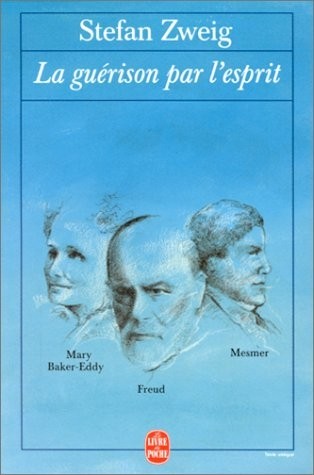
Zweig's errors about Freud and Eddy The Austrian author Stefan Zweig had a notable career before he emigrated to Brazil where he committed suicide in 1942. The hallmark of his popular biographies was the romanticizing (fictionalizing) of the people he depicted, resulting in one critic's comment that "no such characters ever existed." This certainly describes at least two of the three characters he depicts in La Guerison par l'esprit. English title: The Mental Healers: Mesmer, Mary Baker Eddy, Freud (1930)] Sigmund Freud had an early opportunity to correct the egregious errors that occurred in this book, including Zweig's misunderstanding of one of Freud's case histories and some oversimplifications that Freud felt misrepresented his nature. Mary Baker Eddy--who was safely dead and couldn't defend herself--didn't receive due correction until a few years ago - after 65 years of misrepresentation. The publisher's commentary at the end of the 1998 German edition includes a detailed three-page corrective text on Mary Baker Eddy and Christian Science. This is based on Eddy's own writings and scholarly research done in the past few years. Other printings on the market before this German edition, however, do not carry this text. Although Eddy's main work, Science and Health with Key to the Scriptures, had been available in German throughout German-speaking Europe for 20 years when Zweig wrote about Eddy, he never referred to her book and apparently never read it. It has now sold over 10 million copies worldwide in 17 languages--a fact that would be hard to explain if Eddy and Christian Science bore the least resemblance to Zweig's grotesque caricature. Zweig specifically rejected an early biography by Sibyl Wilbur that was published by the Christian Science Publishing Society, because it was favorable to Eddy. He relied instead on a 1909 biography attributed to Georgine Milmine. This was based, in turn, on a 1907-08 series of articles in McClure's Magazine. Both were intended to discredit Eddy and Christian Science while she was still alive. In the Milmine work, Zweig clearly found a character he could "love to hate," and he enhanced the caricature, imagining her motivations and misquoting her writings in German. Among the misrepresentations were: 1) that Eddy had plagiarized Phineas P. Quimby. This claim has been thoroughly researched in several biographies and legally dismissed. 2) that Eddy came from a poor family and was without education. Numerous historical records shows that she came from an educated, substantial farming family and that she received an extraordinary, albeit informal, classical education from an older brother who was a Dartmouth graduate and active in state politics. 3) that Eddy was mentally and physically infirm in her later years and had a stand-in who appeared in public for her. The findings of a panel of legal masters during the "Next Friends" lawsuit and her founding of The Christian Science Monitor in her eighty-seven year contradiction this. That Zweig regretted his own "overzealousness" in portraying Eddy is related in Friderike Zweig's biography of her husband. His presentation of Eddy has, nonetheless, permeated Europe for over 70 years in its many translations. It continues to cited as a legitimate source, and is the basis for a widespread misunderstanding. Readers are advised to look elsewhere for the facts. Science and Health can be read on-line at spirituality.com. A recent definitive biography is by Dr. Gillian Gill, a professor from Yale University who is not a Christian Scientist, is available from amazon.com. This is a scholarly work of 713 pages. Zweig's is a ludicrous psychobiography of 150 pages, based solely on secondary sources. Lucie Barclay
|